

Information About the October 6th Vote
Polls open 12:00-8:00 PM on 10/6 in all towns
Great River Regional School District Proposal
The children of our six towns should have the opportunity to receive a robust education. We have an important opportunity to create something special and exciting to serve current and future generations of students.
The proposed Great River Regional School District is intended to address the educational and financial challenges created by decades of declining enrollment while offering broader educational opportunities for students throughout the region. The proposal reflects the Board's efforts to develop a long-term plan that supports students, communities, and taxpayers.
Regionalization has a long history in Franklin County. In the 1950s, communities came together to create regional school districts (Pioneer Valley in 1957) in response to changing educational needs and community priorities. The STRPB believes that it is important to examine whether a new regional structure can help meet the challenges facing schools and towns today.
It takes courage and a leap of faith to move from the known to the unknown. We did it before with a long-term benefit for our students and communities. We can do it again and give our students the educational experience they deserve.
Read the Regional Agreement Summary
Why is this Being Considered?
Declining Enrollment + Rising Costs
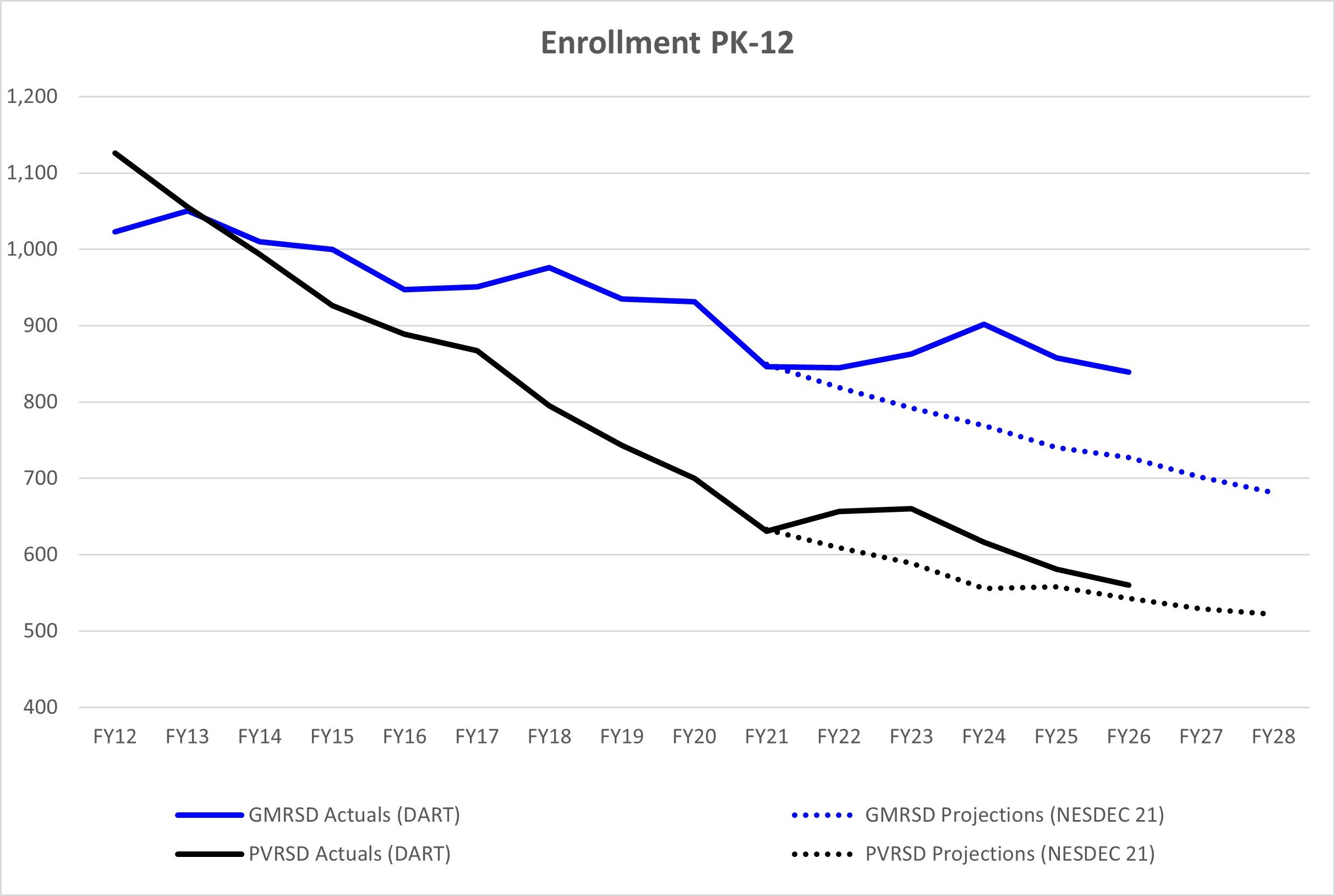
Student enrollment has been declining across the United States as birth rates have decreased over time. Massachusetts has experienced similar trends, losing nearly 15,000 students in the past year alone. In Franklin County, enrollment has declined by nearly 4,000 students over the past 20 years.
Since reaching its peak in 1996, total enrollment has declined significantly in both regional districts:
Gill-Montague enrollment down 50% since 1996
Pioneer Valley enrollment down 53% since 1996
Declining enrollment affects schools in several ways, including reduced state aid, increased per-pupil costs, challenges sustaining academic programs and extracurricular activities, and difficulties maintaining facilities and staffing levels.
The chart below illustrates enrollment trends in both districts and compares actual enrollment to historical projections.
The decline has been driven by:
Lower birth rates (entire country)
Aging population (entire country)
Limited housing (local)
Outmigration of families seeking jobs or housing (local)
This creates challenges:
Higher per-student costs
Reduced programs
Staffing pressures
Difficulty sustaining facilities
In 2019, the six towns created the STRPB to study whether merging districts could improve educational and financial sustainability.
Read the Enrollment Summary

What is being proposed?
Goal: Expand academic opportunities, extracurriculars, and financial sustainability through a larger combined district.
Elementary Schools: All current elementary schools remain open.
Middle School: The Pioneer Valley building
High School: The Turners Falls building
Read the STRPB Long-Range Plan

How could this benefit students?
More course offerings
Expanded athletics and clubs
Access to specialized staff
Peers and opportunities
Stronger long-term programming stability
What is the financial impact?
A Larger Tax Base
A larger district spreads costs over a larger tax base, creating more financial sustainability and resilience.
Administrative efficiencies
New hiring costs spread across more communities
Savings reinvested into student programming
Assessments
The Plan proposes assessments based on a five-year rolling average foundation enrollment to minimize spikes in enrollment fluctuations.
Read the Financial Projections

Transportation
Because the districts are geographically connected:
Elementary students remain in current schools
Some Great Falls Middle / Pioneer Valley High School students may be impacted
Read the Transportation Summary
Governance
If approved, a new School Committee would be formed, including two phases.
Phase One: The first School Committee of the Great River Regional School District would be made up of 13 members. A joint meeting in each town of the current school committee and selectboard members will determine that town’s representation to the Committee.

Phase Two: During a two year non-operational period, the School Committee would set up the governance structure of the district in preparation for its first operational year which would be on July 1, 2028.
The Regional Agreement outlines:
Town representation
Budget process
Voting structure
Existing agreements preserved where possible

How will the decision to regionalize be made?
No changes happen automatically.
Each town votes.
Approval of the Six Town Regional Agreement by all six towns is required under the regionalization process for the Six Town Regional School District to be formed.
Approval of all towns on the Five Town Regional Agreement, not including Warwick, is required for the Five Town Regional School District to be formed.
Six Town Regionalization Presentation
GET INFORMED
Attend informational forums (information on forums will be posted here)
READ OUR FAQ
Need clear answers to:
Will schools close?
Will it save tax dollars?
What happens if towns vote no?
What happens to mascots / traditions?
What happens to staff?
How long would transition take?
TIMELINE
2019 Board Formed
2020-2024 Studies + Informational sessions + Public Input
2024 Recommendation to move forward and Development Regional Agreement
2025 Public Education + Long-Range Plan
2026 Board Approves 5 & 6 Town Agreements + Town Vote
2028 Proposed Launch
IN THE NEWS
July 2025: In the news: Assessment models being prepped for proposed six-town regional school district
OP-ED Articles (external to the Planning Board):
My Turn: Regionalization benefits health of students
Larger Enrollments Will Produce Greater Educational Opportunities For Students
How to roll two regional districts into one